
If your earring holes have slowly crept downward over the years, or if you’ve noticed your piercing is no longer the neat round dot it once was, you are not alone. Elongated earlobes are one of the most common cosmetic concerns among women in India, and in many cases, they have been quietly progressing for years before the person decides to do something about it.
The good news is that elongated earlobes are entirely correctable. Whether your stretching is mild and caught early, or your earlobe has reached the point of tearing, there is an appropriate and effective solution available. This page explains exactly what causes earlobe elongation, how to recognise when correction is needed, and what your options are, including minimum invasive correction, filler, and minimum invasive repair at our earlobe hole repair clinic in Mumbai.
An elongated earlobe refers to a piercing hole that has been pulled, stretched, or worn down from its original position and shape. Instead of the neat, round hole that was created at piercing, the opening becomes oval, slit-like, or elongated, often dropping lower and lower towards the bottom edge of the earlobe.
Left unaddressed, elongation progresses through predictable stages from early stretching all the way to a complete tear of the lobe. Understanding where you are in this progression is the first step towards knowing what kind of correction is appropriate for you.
The process of elongation is gradual and often invisible until it has already progressed significantly. Here is how it typically unfolds:
This process can take years, which is why many patients are surprised by how advanced their elongation is when they first seek help. What felt like a gradual change has often accumulated into a significant issue by the time they act.
India has one of the world’s strongest cultural traditions of ear piercing — with many girls having their ears pierced in infancy or early childhood. This means Indian women typically have several more decades of earring wear than women in many other countries. Combined with a strong tradition of wearing heavy traditional jewellery — jhumkas, chandbaalis, large kadas — the average Indian woman’s earlobes are subjected to far greater cumulative load than those of women who primarily wear lightweight Western styles.
Additional contributing factors specific to the Indian context include:
The result is that elongated earlobes are not an exception among Indian women — they are the norm. Recognising this and addressing it early is one of the most impactful cosmetic corrections a woman can make.
Elongation rarely has a single cause. In most patients, it results from a combination of factors working together over time. Understanding the cause is important because it affects both the type of correction needed and the changes that will prevent re-elongation after treatment.
Gravity is the primary enemy of the earlobe piercing. Every earring exerts a downward force on the piercing hole — and the heavier the earring, the greater that force. Over thousands of hours of wear across years, even a modest weight creates significant cumulative stress on the thin tissue at the top of the piercing hole.
The earrings most associated with earlobe elongation include:
The problem is compounded when earrings are worn continuously — including overnight — which gives the tissue no recovery time and accelerates the weakening of the piercing hole.
A less commonly discussed but clinically significant cause of earlobe elongation is fungal or bacterial infection at or near the piercing site. India’s humid climate — particularly during the monsoon season — creates conditions that favour fungal growth in warm, occluded skin folds.
When an active or recurring infection develops around a piercing hole, several tissue changes occur that directly accelerate elongation:
Patients who have a history of recurrent ear infections — characterised by itching, redness, discharge, or a persistent unpleasant smell around the piercing — may find that their elongation is both more advanced and more irregular in shape than typical weight-related stretching. This is important because it affects the choice of correction technique.
While most elongation is gradual, a significant proportion of complete or near-complete earlobe tears result from a single traumatic event. Common causes include:
In these cases, the tear often happens very quickly and with immediate visible results. However, it is worth noting that trauma-induced tears almost always occur through tissue that has already been weakened by progressive stretching. A healthy, unstretched earlobe is significantly more resistant to tearing than one that has been gradually elongated over years.
This means that for many patients who present with a traumatic tear, addressing the underlying elongation as part of the repair — rather than simply closing the immediate split — produces a far more durable and aesthetically pleasing result.
Many patients live with elongated earlobes for years before seeking help — often because they are not sure whether their concern is significant enough to address, or because they are not aware that effective, low-pain correction options exist.
Here is a clear guide to what to look for and when to seek advice.
These signs indicate that your earlobe is in the early stages of elongation and that early intervention will produce the best and most straightforward result:
At this stage, a minimum invasive correction or filler-based approach may be all that is needed — a quick, low-impact procedure that restores the appearance and prevents further damage.
The honest answer is: earlier is always better. The earlier you seek correction, the simpler and less invasive the required treatment tends to be. However, no matter what stage your elongation has reached, there is an appropriate correction available. This four-stage guide shows where you may be and what is typically recommended:
Stage | Signs | Recommended Action |
Stage 1 – Early Stretch | Piercing hole slightly larger than original; earring sits a little lower | Monitor; switch to lighter earrings immediately |
Stage 2 – Visible Elongation | Clearly oval-shaped hole; earring droops noticeably; skin thins at top | Minimum invasive correction recommended |
Stage 3 – Near Tear | Hole is a long slit; very thin skin bridge remaining; frequent discomfort | Correction now prevents a full tear |
Stage 4 – Complete Tear | Earlobe is fully split; two separate lobes visible; no earring possible | Minimum invasive repair required |
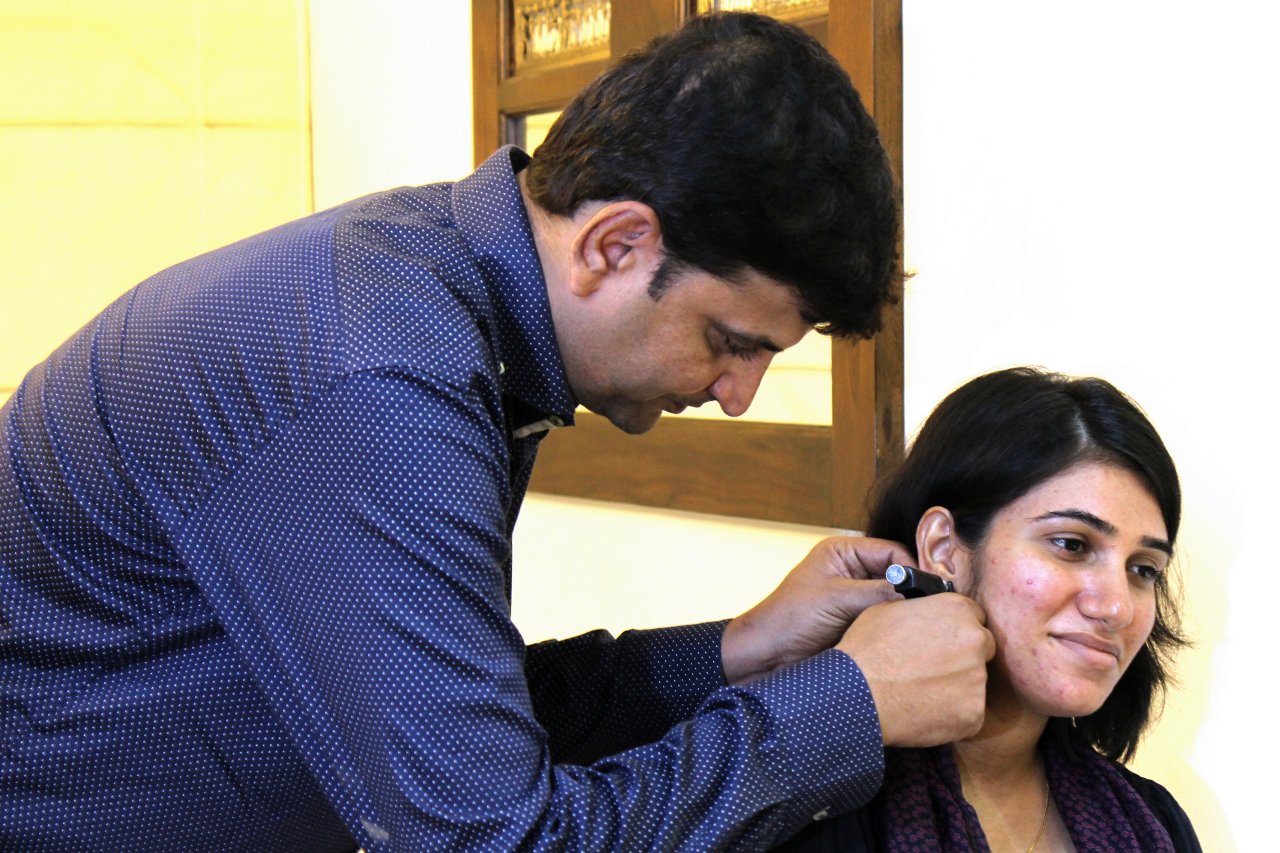
If you are unsure which stage describes your situation, the best course of action is simply to book a consultation. Dr. Lalit and Dr. Poonam Sharma will assess your earlobes in person, explain exactly what they see, and outline the most appropriate and least invasive correction for your specific case.
Yes — and this is one of the most popular requests we receive at our Mumbai clinic. Many patients who have dealt with years of elongation decide that the best path forward is to close the damaged piercing entirely and start fresh with a new, correctly placed earring hole.
This approach offers several advantages: it completely resolves the existing elongation, allows the earlobe to heal and regain its structural integrity, and gives the patient a new piercing in the optimal position for their ear anatomy.
Closing an elongated piercing — particularly one that has progressed to a slit or near-tear — involves a minor but precise procedure. Here is what the process typically involves at our clinic:
The entire closure procedure takes under 30 minutes per ear and can be performed on the same day as the consultation if appropriate.
Having your ears re-pierced after earlobe correction is a moment many patients genuinely look forward to — and the new piercing, placed correctly and allowed to heal properly, should be far more durable and stable than the one it replaces.
Key points about getting a fresh earring hole after correction:
One of the most important aspects of earlobe correction that is rarely discussed is the role of skin type. India has an extraordinarily diverse population with a wide range of skin types, tones, and characteristics — and each of these affects how a correction should be approached, how the earlobe will heal, and what aftercare is most important.
At our clinic, we never apply a one-size-fits-all approach. Here is how we adapt our technique and aftercare for the full range of skin types we work with:
Skin Type | Key Characteristics | Our Approach |
Normal / Balanced Skin | Heals predictably; good elasticity | All correction options suitable; excellent prognosis |
Dry / Thin Skin | Lower elasticity; slightly slower healing | Gentle technique; extra moisturising aftercare recommended |
Oily Skin | More prone to pore blockage at piercing site | Thorough cleansing protocol; monitor for post-care congestion |
Sensitive / Reactive Skin | May react to materials; heightened post-care needs | Hypoallergenic materials only; patch check before procedure |
Mature Skin (40+) | Reduced collagen; slower healing; lower elasticity | Combined correction + filler for volume; careful aftercare |
South Asian Skin Types | Post-inflammatory hyperpigmentation risk | Low-trauma technique; SPF protection post-procedure essential |
During your consultation, Dr. Lalit or Dr. Poonam Sharma will assess your skin type as part of the overall evaluation and factor this directly into their recommended technique, material choices, and aftercare plan. This personalised approach is what produces consistently excellent results across the diversity of patients we serve in Mumbai.
Minor early-stage stretching may stabilise if you stop wearing heavy earrings immediately — but an elongated hole will not return to its original shape on its own. The tissue that has been stretched does not simply contract back. To restore the correct shape, a professional correction procedure is needed.
No. With appropriate numbing, the correction procedure is not painful for the vast majority of patients. You may feel mild pressure or movement during the procedure, but not pain. Any soreness afterwards is typically very mild and resolves within a day or two.
Most elongated earlobe corrections take between 15 and 45 minutes per ear, depending on the degree of stretching. Minimum invasive approaches are typically quicker; minimum invasive corrections take slightly longer but are still completed within the same appointment.
Our technique is designed to minimise scarring. Minimum invasive corrections leave no scar. Minimum invasive repairs leave a very fine, faint scar that typically fades to near-invisibility within a few months. For patients with South Asian skin tones, we apply specific protocols to reduce the risk of hyperpigmentation at the repair site.
Yes — and most patients prefer to have both ears addressed at the same time for convenience and symmetry. Both corrections can typically be performed within the same appointment, with the total time depending on the degree of correction required on each side.
For minimum invasive corrections, light studs can often be worn within 6–8 weeks with medical clearance. After a surgical repair, we recommend waiting the full 6–8 weeks minimum before any earring wear, with a further gradual introduction of heavier styles over the following months.
Yes, absolutely. Baby ear piercings that have elongated over the years are one of the most common presentations we see at our Mumbai clinic. The correction approach depends on the current degree of elongation. Many of these cases are suitable for minimum invasive or minimal-intervention correction, producing natural and lasting results.
Recurrent or untreated fungal and bacterial infections at the piercing site can accelerate elongation and cause irregular hole shape or tissue thinning. Once the infection is resolved and the earlobe has recovered, correction is still possible in most cases. Your doctor will assess the tissue carefully and advise the best approach for your specific situation.
Earlobe correction is considered a cosmetic procedure and is not typically covered by standard health insurance in India. However, at our clinic we believe effective, lasting correction should be accessible — and we are always happy to discuss your options during a consultation.
Copyright @2021 Design & Developed By Namastetu Technologies
Copyright @2026 Design & Developed By Namastetu Technologies Pvt. Ltd
Specialized care for ear hole repair and restoration with precision and compassion.